Strapi Review
Open-source headless CMS with AI-powered content management and API-first design
Open-Source Tools · Open Source · OPEN SOURCE
Overview
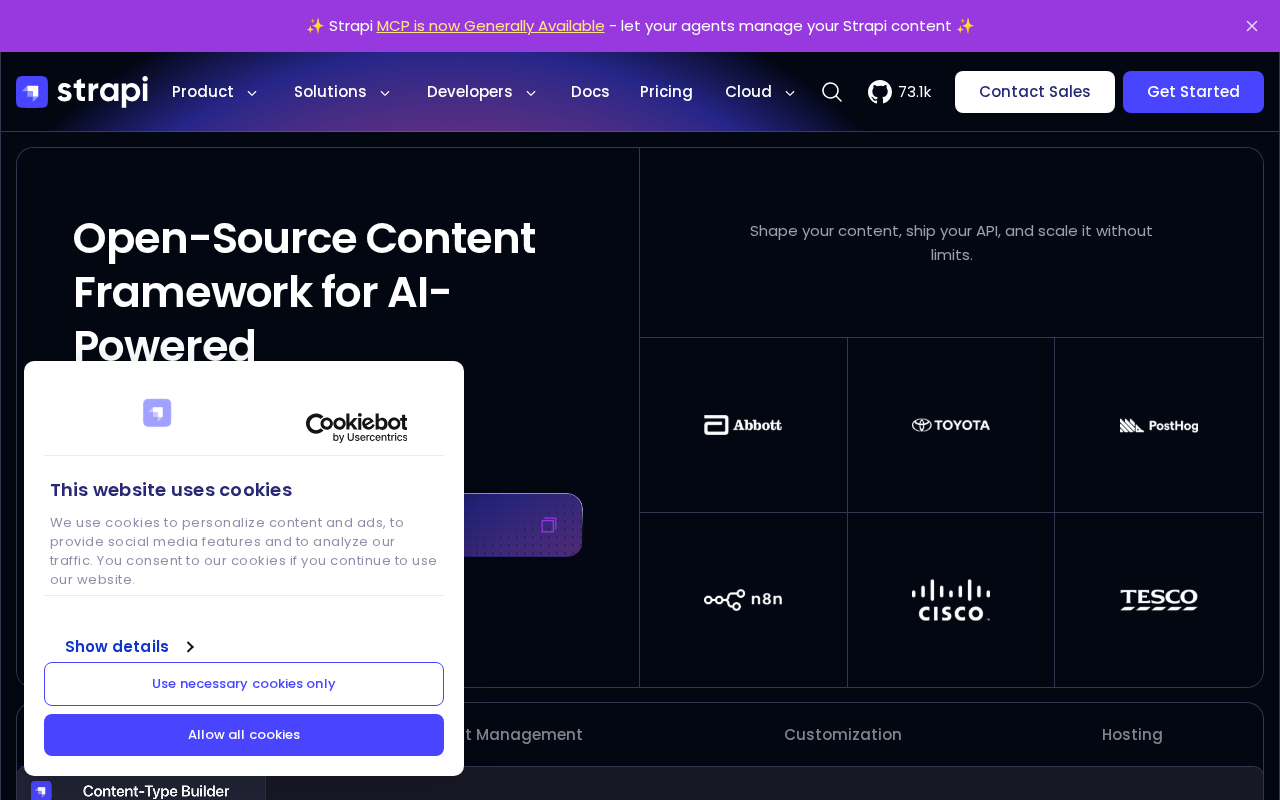
Developed in Paris and launched in 2015, Strapi is an open-source headless CMS that gives marketing and engineering teams a centralized place to model, manage, and distribute content across websites, apps, and digital products. Its API-first architecture lets teams deliver structured content to front ends built with Next.js, Nuxt, Gatsby, and other frameworks, while integrations such as Zapier, Slack, Stripe, Algolia, and Cloudinary support common martech and commerce workflows. Because the core project is MIT licensed and publicly maintained, with more than 72,000 GitHub stars, organizations can inspect the code, self-host it, or extend it without relying on a closed platform. Strapi is aimed at teams that need flexible content infrastructure rather than a traditional page-builder CMS. Its differentiators include customizable content types, role-based access, localization support, and a developer-friendly admin panel that can be adapted to editorial and campaign operations. AI features can assist with content generation, content workflows, media management, and translation, helping teams reduce manual production work while keeping human review in place. Pricing ranges from free self-hosted use under MIT to a free Cloud Developer plan, paid Pro at $99 per month, Team at $499 per month, and custom Enterprise agreements. Compared with commercial headless CMS platforms, Strapi generally offers greater control and lower entry cost, though self-hosting may require more internal development and maintenance resources. It fits technical marketing teams, agencies, and product organizations that want an open-source, API-driven CMS with AI-assisted content operations and the flexibility to deploy content wherever it is needed.
AI Capabilities
- AI content generation
- AI content workflows
- AI-powered media management
- AI translation
Key Integrations
Pricing
Strapi is free to self-host, paid plans start at $99/mo.
Self-hosted free (MIT); Cloud Developer free; Pro $99/mo; Team $499/mo; Enterprise custom
Current plans and limits live on the Strapi pricing page.
Review notes
Researched from public documentation, the source repository, and vendor materials. Not a hands-on test.
Strapi is the headless CMS we reach for when content models are unusual. Content types are built visually, the REST and GraphQL APIs generate automatically, and the admin panel needs zero frontend work. Self-hosting is straightforward with Docker, and v5's type generation tightened the developer loop further.
It is a framework as much as a product: complex content relations require real development time, and major version upgrades have historically needed migration attention. Editorial teams wanting WYSIWYG-heavy publishing flows will find it spartan compared to hosted CMS platforms.
Verdict
Our default headless CMS for custom builds; choose it for flexibility, not for turnkey publishing polish.
Pros and cons
| Pros | Cons |
|---|---|
| ✓ Open-source licensing with free self-hosting | ✗ Paid plans start at $99/mo once past the free tier |
| ✓ AI capabilities: AI content generation | |
| ✓ Established community (73,109 GitHub stars) | |
| ✓ Native integrations include Next.js, Nuxt, Gatsby (8 listed) |
Building your martech shortlist?
The weekly newsletter: one tool teardown, one workflow, no fluff. Free.
Frequently asked questions
What is Strapi?
Open-source headless CMS with AI-powered content management and API-first design. It ships with AI content generation, 73,109 GitHub stars. MartechSignal's review covers features, pricing, and how it compares to alternatives.
How much does Strapi cost?
Strapi has a free tier; paid plans start at $99/mo.
Is Strapi a good Open Source Tools tool in 2026?
Our default headless CMS for custom builds; choose it for flexibility, not for turnkey publishing polish.