Pipedream Review
Workflow automation with 2,500+ integrations, built around data-driven triggers and HTTP steps
Workflow Automation · Paid
Overview
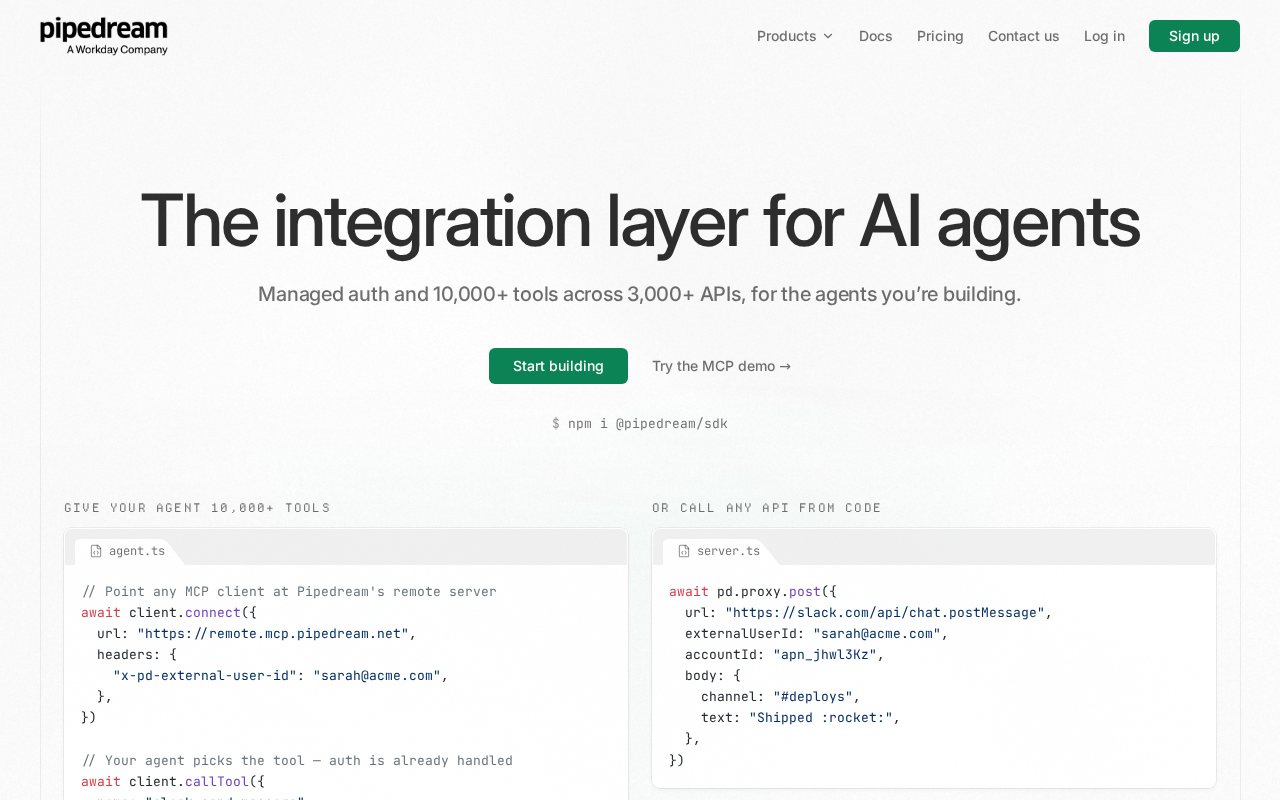
Pipedream is a developer-first integration and automation platform that connects over 3,000 APIs, AI models, databases, and services through code-level workflows. Founded in 2019 and acquired by Workday in 2026, it serves over one million developers, from startups to Fortune 500 companies including LinkedIn, Scale AI, and Warner Bros. Discovery. The platform spans four product surfaces. There is a visual Workflow Builder where steps can be no-code integrations or arbitrary Node.js, Python, or Go code. Connect is an SDK that lets product teams embed Pipedream's 3,000+ integrations into their own applications or AI agents with managed OAuth. MCP servers deploy integrations as tool endpoints that any Model Context Protocol client can call, including Claude, Cursor, and Copilot. And String is an AI agent builder where users describe what they want in natural language and Pipedream generates, deploys, and hosts the agent. The platform includes 10,000 pre-built triggers and actions, a built-in key-value data store, file storage, concurrency controls, and GitHub Sync for version-controlled workflow deployment across environments. Security certifications include SOC 2 Type II, HIPAA compliance, and GDPR. Pricing is credit-based, so you pay for compute time. The Free tier includes 100 credits per month with 1 million AI tokens, 3 active workflows, and 3 connected accounts. The Basic plan at $29/month includes 2,000 credits and 20 million AI tokens. The Advanced plan at $49/month adds unlimited workflows and accounts, control flow operators (branching, parallelism, switch), premium apps, and GitHub Sync. The Connect plan at $99/month is for teams embedding integrations in their own products, with managed auth for up to 100 external users. Business plans are custom-quoted with volume pricing, dedicated Slack support, HIPAA workloads, and SLAs. Pipedream competes with Zapier, Make, n8n, Tray.io, and Workato, but sets itself apart on developer flexibility. Every step can run arbitrary code, which pure no-code tools cannot do, while still providing managed auth, a pre-built integration catalog, and an execution environment that infrastructure tools like AWS Lambda leave you to build yourself. Its MCP server deployment capability is unusual in the category: marketers or developers can turn any Pipedream workflow into an MCP server endpoint that AI coding agents call directly, which makes it a bridge between traditional iPaaS automation and agentic workflows. The Workday acquisition points toward deeper enterprise integration, particularly around the HR, finance, and planning systems where Workday is dominant. For marketing and revenue operations teams, the strongest use cases are data pipelines between martech tools (routing leads from ad platforms to CRMs, enriching contact data across systems, syncing campaign metrics to dashboards), AI-powered content workflows triggered from webhook events, and internal tools that combine multiple marketing APIs into single endpoints.
Review notes
Researched from public documentation, the source repository, and vendor materials. Not a hands-on test.
Pipedream sits between Zapier and raw code: workflows are Node, Python, or Go steps you write, with pre-built connected components handling auth for hundreds of APIs. When a workflow needs a real conditional or a custom API call, dropping into code beats fighting a blocks-only builder.
The free development tier is generous, and production pricing by execution is predictable. Teams wanting purely no-code will find it programmer-ish; teams wanting code control with managed auth and scheduling will feel at home immediately.
Verdict
The automation platform for developers who want code control with SaaS convenience.
Pros and cons
| Pros | Cons |
|---|---|
| ✗ Closed source - no self-hosting option |
Building your martech shortlist?
The weekly newsletter: one tool teardown, one workflow, no fluff. Free.
Frequently asked questions
What is Pipedream?
Workflow automation with 2,500+ integrations, built around data-driven triggers and HTTP steps. MartechSignal's review covers features, pricing, and how it compares to alternatives.
How much does Pipedream cost?
Pipedream uses paid pricing. See the vendor's pricing page for current plans.
Is Pipedream a good Workflow Automation tool in 2026?
The automation platform for developers who want code control with SaaS convenience.