OpenSEO Review
Open source alternative to Ahrefs and Semrush
SEO & Search · Open Source · OPEN SOURCE
Overview
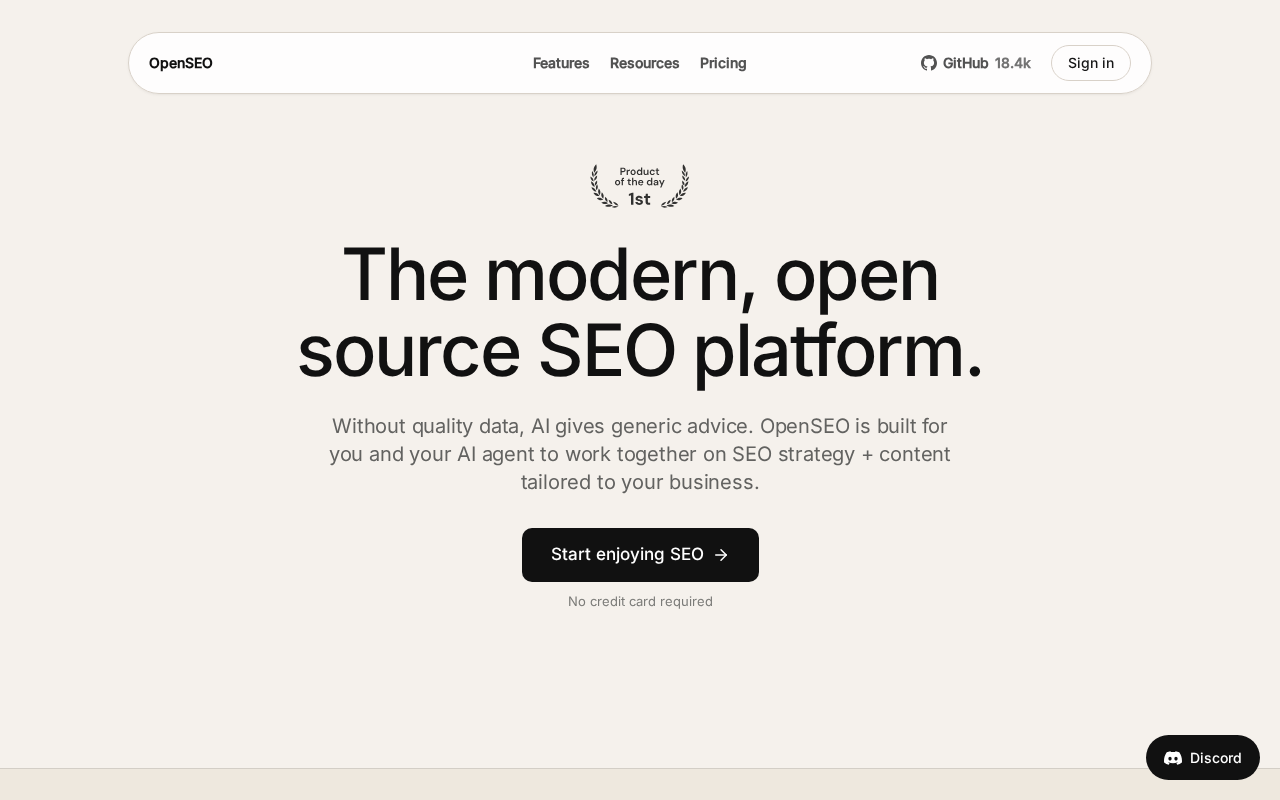
OpenSEO is an open-source, self-hosted SEO platform covering keyword research, rank tracking, competitor insights, backlink analysis, site audits, and AI search visibility, positioned as an alternative to Ahrefs and Semrush. The TypeScript project (repo every-app/open-seo) is MIT-licensed, held around 17,700 GitHub stars as of September 2026, and has moved quickly since its February 2026 debut: AI Visibility and Prompt Explorer landed in April, an MCP server in May, agent skills and multi-project support in June, Local SEO in August, and on-demand SERP depth on September 2. Two deployment paths are documented. Docker is described as best for testing: clone the repo, copy .env.example to .env, and run docker compose up -d, which serves on port 3001 with authentication disabled, so it belongs behind your own reverse proxy or private network. For an internet-facing or team install the README recommends the Cloudflare path, where pnpm deploy:selfhost provisions D1, KV, R2, and a Cloudflare Access gate on Cloudflare's free plan. Data is the real cost. OpenSEO is a front end over DataForSEO: you bring your own API key (the base64 of your DataForSEO email and password), pay that vendor directly for what you use, and add a separate OpenRouter key for AI features such as SAM, the in-app SEO agent. New DataForSEO accounts include $1 of credit and the minimum top-up is $50. The hosted service at openseo.so charges $10/month including $10 of usage, and the README states plainly that the hosted margin is a 28% surcharge on every DataForSEO request, so self-hosting is slightly cheaper. Rank tracking defaults to weekly, and the docs note that daily checks use seven times more credits. Google Search Console and Google Analytics data is free. The trade-off is the usual one: you own the interface, the scheduling, and your own database, not the crawl index.
Pricing
OpenSEO is free to self-host under the MIT licence.
Self-hosted free (MIT); you pay DataForSEO directly per call. Hosted: $10/mo including $10 of usage.
Current plans and limits live on the OpenSEO pricing page.
How to install
- Docker, which the README calls best for testing: git clone https://github.com/every-app/open-seo.git, cd open-seo, cp .env.example .env, then docker compose up -d. The image is ghcr.io/every-app/open-seo:latest and the app listens on port 3001.
- Set DATAFORSEO_API_KEY in .env to the base64 of your DataForSEO login in the documented format email:password (printf '%s' 'email:password' | base64). AI features such as SAM also need OPENROUTER_API_KEY.
- For an internet-facing or team install, the documented path is Cloudflare: corepack enable, pnpm install, pnpm alchemy login, pnpm alchemy cloudflare bootstrap, cp .env.selfhost.example .env.selfhost, then pnpm deploy:selfhost --yes.
- Team access on the Cloudflare path is a matter of adding emails to ACCESS_ALLOWED_EMAILS in .env.selfhost and redeploying; everyone who passes Cloudflare Access works in one shared workspace.
- Local development: pnpm install --frozen-lockfile, pnpm run db:migrate:local, pnpm run dev. Telemetry can be turned off with OPENSEO_TELEMETRY_DISABLED=1.
Requirements
Docker plus a funded DataForSEO account for search data, and an OpenRouter key if you want the AI features, or Node 22.6 or newer plus a Cloudflare account with R2 for the self-host deployment, which the docs say works on Cloudflare's free plan. Docker self-hosting runs in local no-auth mode, so the docs expect a reverse proxy, tunnel, or private network in front of it. No hardware sizing is published.
Best for
Indie SEOs, startups, and small agencies that want keyword research, rank tracking, audits, backlink checks, and AI mention tracking in one self-hosted interface, and that would rather pay DataForSEO per call than carry an Ahrefs or Semrush subscription. Teams already working with coding agents get an MCP server and documented agent skills.
Not for
Buyers expecting Ahrefs-scale clickstream backlink data, teams that need daily rank checks on a budget (the docs price daily at seven times weekly credits), and non-technical marketers: self-hosting ships with authentication off and assumes you can put an access layer in front of it.
Review notes
Assessed from the repository, openseo.so, and the self-hosting docs in September 2026; we have not deployed it. The project is young and fast. The repo was created in February 2026 and the release notes read as a feature a fortnight: AI Visibility (v0.0.8, April), an MCP server (v0.0.11, May), agent skills (v0.0.15), multi-project support with Share of Voice (v0.0.19, June), Local SEO MCP (v0.1.5, August), and on-demand SERP depth (v0.1.7, September 2).
The correction against our earlier record: the claim that self-hosting runs at 10-20% of SaaS SEO cost was ours, not the project's, and appears in no OpenSEO source. The documented anchors are different. The hosted plan is $10/month including $10 of usage, the README states the hosted service charges 28% extra on every DataForSEO request, and the site's own comparison points at Ahrefs' cheapest plan at $129/month. Rank tracking also defaults to weekly rather than daily; daily is an option that costs seven times more credits.
The feature set is wider than we previously recorded. Beyond keyword research, domain overview, backlinks, and audits, the documented workflows include Competitor Insights, AI Visibility and Prompt Explorer for LLM mentions, citations, and prompts, Local SEO built on Google Business Profile data, and an in-app SEO agent called SAM that runs on OpenRouter. Eight agent skills are documented, from keyword clustering to link prospecting.
The dependency question is unchanged and the project does not dress it up: OpenSEO queries DataForSEO, described in its own docs as a pay-as-you-go third-party service unaffiliated with the project. What you own is the interface, the scheduling, the reports, and a database you control (D1 SQLite by default, with an opt-in Postgres backend), not the crawl index behind the numbers.
Verdict
A fast-moving self-hosted SEO workbench with a genuine AI-visibility layer and usage-based data costs; bring a DataForSEO budget and some ops appetite.
Pros and cons
| Pros | Cons |
|---|---|
| ✓ MIT licence with free self-hosting | ✗ No hands-on test - this assessment is based on vendor documentation and the public repository |
| ✓ Established community (18,155 GitHub stars) |
Building your martech shortlist?
The weekly newsletter: one tool teardown, one workflow, no fluff. Free.
Frequently asked questions
What is OpenSEO?
Open source alternative to Ahrefs and Semrush. It ships with 18,155 GitHub stars. MartechSignal's review covers features, pricing, and how it compares to alternatives.
How much does OpenSEO cost?
OpenSEO is open source - MIT licensed and free to self-host; the public repository carries 18,155 stars. You pay in server time and maintenance, not licences.
Is OpenSEO a good SEO & Search tool in 2026?
A fast-moving self-hosted SEO workbench with a genuine AI-visibility layer and usage-based data costs; bring a DataForSEO budget and some ops appetite.
What does OpenSEO cost to run on my own DataForSEO account?
You pay DataForSEO directly at its published rates. The docs state that new DataForSEO accounts include $1 of free credit and that the minimum top-up is $50, and the README says self-hosted costs come in slightly lower than the estimates on the OpenSEO website because the hosted service charges 28% extra on every request it makes to DataForSEO. For reference, hosted OpenSEO is $10/month including $10 of usage, with one keyword search quoted at about $0.05 and a domain overview with a year of history at about $0.08.
How often does OpenSEO check keyword positions?
Rank tracking schedules are Daily, Weekly, Monthly (end of month), and Manual only, with weekly as the default. The docs note that daily checks use seven times more credits than weekly ones, and that deeper SERP depth costs more, with ten pages of results quoted as roughly eight times the cost of one page. Google Search Console data is free and does not draw on your paid usage.
Does the self-hosted version include the AI features?
Only if you supply keys for them. AI features such as SAM, the in-app SEO agent, require an OpenRouter API key in your environment file, and AI Visibility is powered by DataForSEO's LLM mention endpoints, so those calls bill against your DataForSEO account like any other query. The MCP server and the agent skills themselves ship in the repository with no extra licence.