MarketMuse Review
AI-powered content strategy and optimization platform for SEO content teams
SEO & Search · Paid
Overview
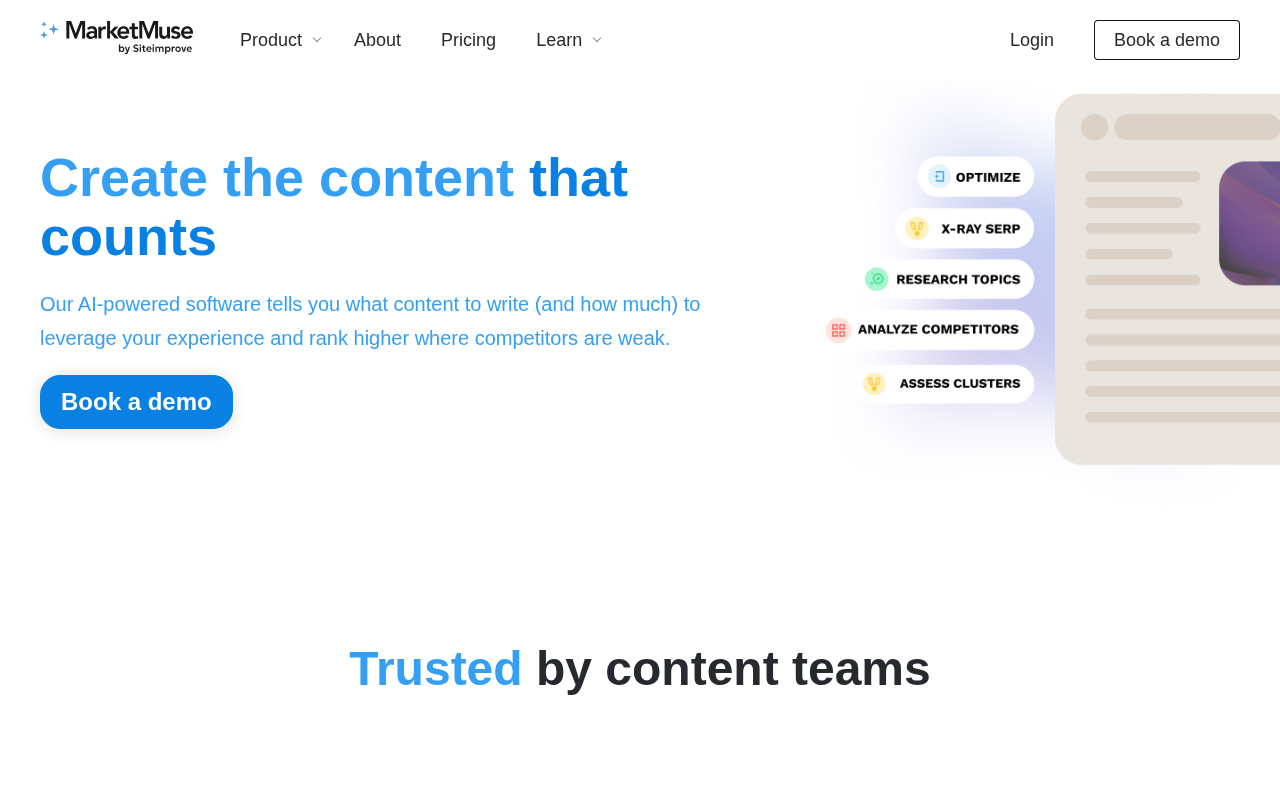
MarketMuse is an AI content strategy and optimization platform that approaches SEO from the top down: rather than scoring one article at a time, it inventories your entire site, models the topics you cover, and grades your coverage against competitors across all of them. It was founded in July 2013 by Aki Balogh, is based in Boston, and was acquired by Siteimprove in October 2024; along the way it bought the Grepwords keyword database in 2021 and holds a patent on semantic keyword analysis. The documented product is four applications: Optimize for writing and scoring against briefs, Research with seven named tools (Topic Navigator, Keywords, Questions, Reflect, SERP X-Ray, SERP Heatmap, Site Heatmap), Heatmap for site-wide coverage, and Connect for internal linking. Proprietary metrics include Personalized Difficulty, Topic Authority, Competitive Advantage, Content Score, and Page Authority. Generative AI is documented rather than implied: MarketMuse AI arrived in Optimize in October 2023 as an LLM-agnostic drafting layer, and Content Strategy AI followed in August 2024 with prescriptive documents the company says compress 50+ hours of analyst work into 15 minutes. Briefs come in nine types, from Comparison and FAQ Collection to How-to and Product Review. The trade-offs are real. There is no documented API and no integrations page: writing exports to Google Docs or Word, WordPress gets copy-paste via a Copy for Publishing button, and ChatGPT is the one documented third-party connection. Pricing is no longer self-serve either: the site lists Free, Optimize, Research, and Strategy plans, but every paid tier sits behind a Book a demo button, with limits published instead of dollars (the Free plan allows 10 queries a month; Strategy covers 10,000 tracked topics and 5 users). Public product momentum is thin, with the newest docs changelog entry dated February 2024. It fits content teams that need portfolio-level planning more than per-article nudging.
AI Capabilities
- AI content strategy documents (Content Strategy AI)
- AI drafting in Optimize (MarketMuse AI)
- AI content briefs in 9 documented types
- Patented topic modeling
Key Integrations
Pricing
MarketMuse is sold on paid plans.
No published prices. Plans: Free (10 queries/mo), Optimize, Research, Strategy; all paid tiers are demo-gated. Optimize: 1 user, 100 tracked topics, 5 briefs/mo. Research: 3 users, 1,000 topics, unlimited queries. Strategy: 5 users, 10,000 topics, all 9 brief types.
Current plans and limits live on the MarketMuse pricing page.
How to install
- No install: hosted SaaS. Create a free account at app.marketmuse.com with an email address and password (the account docs also describe 2FA). The pricing page's Start my free trial link points to app.marketmuse.com/welcome, a JavaScript-only app that states no trial terms we could read.
- First-run setup is an inventory crawl: the docs say MarketMuse reads and analyzes the content on your website, which takes 10 to 30 minutes for a site with fewer than 16,000 topics. Topics and URLs can also be added manually, with data appearing in about 5 minutes.
- Bulk inventory is CSV with a documented maximum of 500 rows per file. Extra user seats and topic packs are added under Settings, Subscription (Users and Inventories).
- Content leaves by export: Optimize exports writing to Google Docs or Word, briefs export to both, and a Copy for Publishing button hands formatted text to WordPress or HubSpot. Up to 7 competitor URLs can be excluded from Connect's linking recommendations.
- Paid tiers route through a Book a demo form at marketmuse.com/book-demo. The docs describe in-app subscription management only for customers who signed up and paid on the web.
Requirements
A browser and a site to crawl: the inventory analysis is the core setup step and the docs size it at 10 to 30 minutes for sites under 16,000 topics. No API keys, SDKs, or connector work, because no API is documented. Password policy is at least 10 characters with a special character, a number, and an uppercase letter; 2FA is available.
Best for
Content teams with a large existing library that need portfolio-level decisions: which topics to build out, which pages to refresh, and where a competitor out-covers them. Research and Heatmap are the deep end, and the nine brief types give writers structured starting points rather than empty outlines.
Not for
Developers and ops teams: there is no documented API, no Zapier, no Google Search Console connection, and writing leaves by export or copy-paste. Also not for self-serve buyers who want a published price, since every paid plan now sits behind a demo form and the Free plan caps at 10 queries a month.
Review notes
Assessed from marketmuse.com, docs.marketmuse.com, and the pricing page in September 2026; we have no MarketMuse account and have not run an inventory. The site reads as a planning tool rather than a word processor: Optimize, Research, Heatmap, and Connect are the documented applications, and the research side carries seven named tools from Topic Navigator to SERP X-Ray.
Corrections against our earlier record. Founding is July 2013 by Aki Balogh in Boston, not 2015 in Montreal. The price list is gone: the $99, $149, $249, and $499 figures we published appear nowhere on the current pricing page, which gates all four plans (Free, Optimize, Research, Strategy) behind a demo form and prints limits instead of dollars. Our claim that the top plan included API access is unsupported, because no API is documented anywhere on the docs site.
Integrations were overstated too. Google Docs and Word are export targets, not connectors; WordPress gets a documented copy-paste path instead of a plugin; ChatGPT (April 2023) is the one documented third-party link; and we found no evidence for Zapier or Google Search Console.
The acquisition is the fact a buyer needs: Siteimprove acquired MarketMuse in October 2024, the docs now carry Siteimprove branding, and the product is marketed as MarketMuse by Siteimprove. Public momentum since then is thin: the newest entry in the docs' Platform Updates section is from February 2024, and the newest dated post in the blog's news category is the acquisition announcement itself.
Verdict
Genuine topic-level planning depth, now wrapped in demo-gated pricing, Siteimprove ownership, and a public changelog quiet since early 2024; probe both the roadmap and the quote before committing.
Pros and cons
| Pros | Cons |
|---|---|
| ✓ AI capabilities: AI content strategy documents (Content Strategy AI) | ✗ Closed source - no self-hosting option |
| ✓ Native integrations include Google Docs (export), Microsoft Word (export), WordPress (copy-paste) (4 listed) |
Building your martech shortlist?
The weekly newsletter: one tool teardown, one workflow, no fluff. Free.
Frequently asked questions
What is MarketMuse?
AI-powered content strategy and optimization platform for SEO content teams. It ships with AI content strategy documents (Content Strategy AI), 4 listed integrations. MartechSignal's review covers features, pricing, and how it compares to alternatives.
How much does MarketMuse cost?
MarketMuse no longer publishes prices. The pricing page lists four plans (Free, Optimize, Research, Strategy) and every paid tier's call to action is Book a demo.
Is MarketMuse a good SEO & Search tool in 2026?
Genuine topic-level planning depth, now wrapped in demo-gated pricing, Siteimprove ownership, and a public changelog quiet since early 2024; probe both the roadmap and the quote before committing.
How much does MarketMuse cost in 2026?
MarketMuse no longer publishes prices. The pricing page lists four plans (Free, Optimize, Research, Strategy) and every paid tier's call to action is Book a demo. Limits are published instead: Optimize covers 1 user, 100 tracked topics, and 5 content briefs a month; Research covers 3 users, 1,000 tracked topics, and unlimited queries; Strategy covers 5 users, 10,000 tracked topics, and all nine brief types. The terms of service say fees are payable in US dollars as specified on the invoice, and the docs note that some self-serve customers can still manage a subscription in Settings.
Does MarketMuse have an API or a WordPress plugin?
We found no API documentation anywhere on docs.marketmuse.com, and the site has no integrations page (the /integrations URL returns 404). Getting content out is manual by design: Optimize exports to Google Docs or Word, a Copy for Publishing button hands formatted text to WordPress or HubSpot, and the ChatGPT connection from April 2023 is the one documented third-party link. Plan for export-and-paste in your workflow, or ask the sales team directly whether API access exists.
What is a MarketMuse query and how many do I need?
A query is spent when you enter a focus topic into one of the applications (Research, Compete, or Optimize). The Free plan includes 10 queries a month, Optimize 100, and Research and Strategy are unlimited, so a solo user testing workflows will exhaust the free ceiling in one planning session. Tracked topics and content briefs are counted separately, and both extra seats and extra topics can be purchased as add-ons under Settings, Subscription.