Maizzle Review
Modern email development framework using Tailwind CSS for responsive campaigns
Email Marketing · Free · OPEN SOURCE
Overview
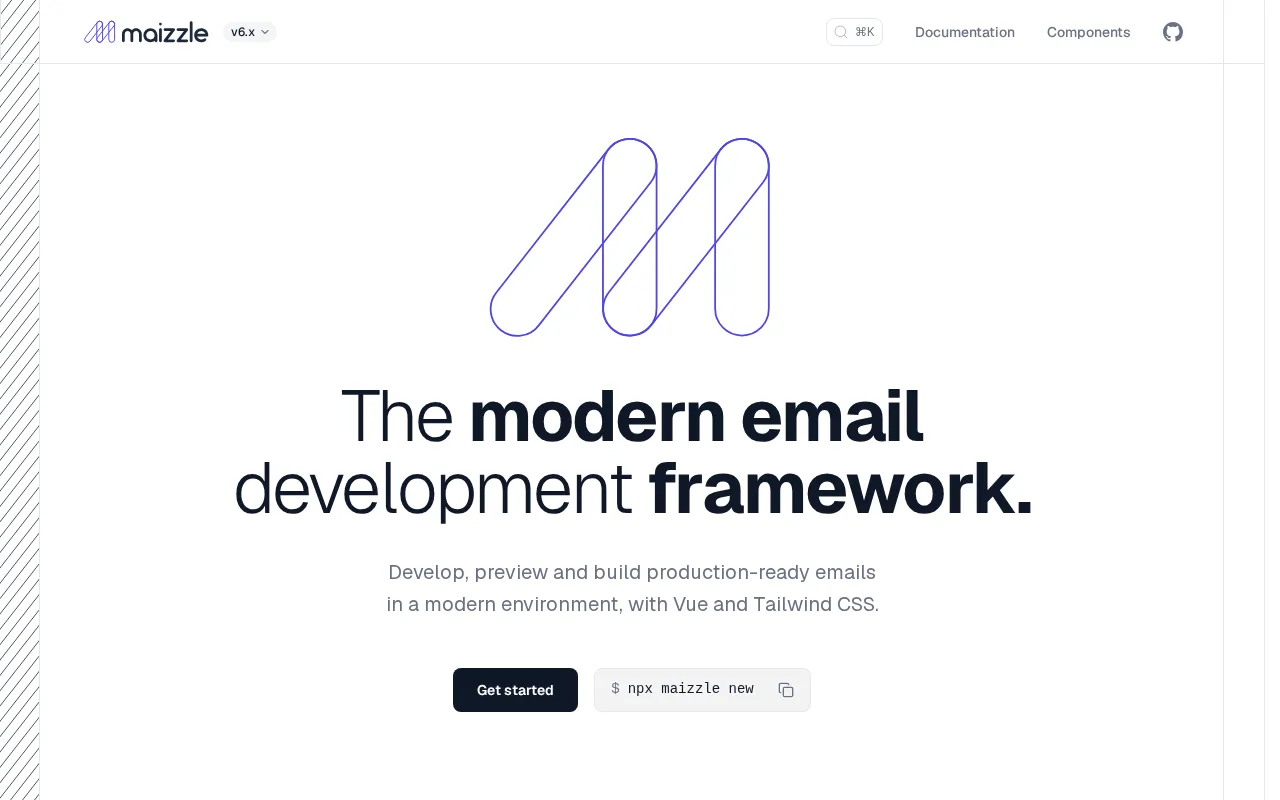
Maizzle is an MIT-licensed email development framework that compiles Tailwind CSS into email-safe HTML, and version 6, released in June 2026 after 26 release candidates and a complete rewrite, runs on Vite with Vue templates and Tailwind CSS 4. You write Tailwind classes in Vue single-file components, and the build runs a configurable pipeline of transformers: CSS inlining, unused CSS removal, minification, six-digit hex conversion, link and attribute handling, all of which are on by default in v6. The output is production HTML with inlined styles and Outlook fallbacks that you upload to your ESP or hand to a sending service. More than 30 documented components cover responsive layouts, buttons that survive Outlook, dark-mode images, and VML background pieces through dedicated Outlook components; the project claims render testing against Apple Mail, Gmail, Yahoo, and Outlook with compatibility over 95% of email clients. The v6 dev server adds live preview with hot reload, device resizing, dark-mode emulation, compatibility checks that link out to caniemail.com data, command-palette search, and test email sending. Scaffolding is one command (npx maizzle new), environments are config files rather than flags, and a render() and build() API plus a Vite plugin cover Laravel, Nuxt, SvelteKit, and Astro integration. Deployment guides exist for Nodemailer, SendGrid, Mailgun, Postmark, Resend, SES, and Cloudflare, with migration guides from React Email and MJML, and the docs publish an agent skill for coding assistants. Scope stays honest: Maizzle builds templates, it does not send campaigns, manage lists, or report analytics, and there is no visual editor; Mailviews, the commercial template product, is separate. Developers maintaining many templates get versioned, reviewable email code, and marketers who want drag-and-drop need a different category of tool.
How to install
- Scaffold a project: npx maizzle new (interactive), or non-interactively npx maizzle new maizzle/maizzle project-name --install, which uses the starter.
- Develop locally: cd project-name && npx maizzle serve (maizzle dev is an alias). Options include --port and --host. The starter's package.json wires dev, build, and a postinstall maizzle prepare step.
- Build for production: npx maizzle build, with flags for --output, --dir, --ext, --pretty, --minify, and --plaintext.
- Per-environment builds are config files, not flags, in v6: npx maizzle make:config production writes production.config.ts, and you build with npx maizzle build --config maizzle.production.ts. There is no --env flag in v6.
- Generators cover the rest of the workflow: npx maizzle make:template, make:layout, and make:component.
Requirements
Node.js and npm to run the CLI; no specific Node version is documented in the framework package.json or the installation docs. No database, server, or runtime dependency beyond the build step, since output is static HTML you deploy to your own sending stack.
Best for
Developer-led teams and agencies that maintain many email templates in version control and want Tailwind ergonomics, component reuse, and reliable Outlook handling at build time, with output that drops into any ESP or sending API.
Not for
Marketers who want a visual drag-and-drop editor (there is none; Mailviews is the separate commercial product), and teams that want sending, list management, or analytics from the same tool, since Maizzle deliberately stops at compiled HTML.
Hands-on notes
Assessed from maizzle.com/docs and the maizzle/framework releases; we have not built templates with it. Activity is the strongest signal: v6.0.0 landed June 9, 2026 after 26 release candidates, and 236 commits plus point releases followed, including v6.1.3 on September 7, 2026.
Version 6 is a rewrite, not an increment, and the upgrade guide is blunt about the breakage: templates move from PostHTML HTML to Vue single-file components, front matter is replaced by defineConfig() in script setup, config.js becomes maizzle.config.ts, the outlook config key is replaced by an Outlook component, and CSS inlining, purging, shorthand, and HTML formatting are now always on. Tailwind CSS 4 support arrives with a bundled @maizzle/tailwindcss email config that replaces v5's tailwindcss-preset-email. Existing v5 projects should budget real migration time and read the guide first.
The repo layout changed with v6 and matters for evaluation: the engine lives in maizzle/framework (with the bulk of the commit history) while maizzle/maizzle is the starter template repository at 2,800-plus stars. Issues are directed at the framework repo.
Two boundaries the docs leave explicit or absent: there is no documented Node version requirement, and Google Fonts support in v6 links a stylesheet through the Font component rather than documenting font CSS inlining. Neither blocks adoption, but both are worth knowing before you promise font behavior to a client.
Verdict
The strongest answer for developer-maintained email templates in 2026, now on Tailwind 4 and Vite; budget migration time from v5, and keep a separate tool for sending and analytics.
Pros and cons
| Pros | Cons |
|---|---|
| ✓ Open-source licensing with free self-hosting | |
| ✓ Established community (2,848 GitHub stars) |
Building your martech shortlist?
The weekly newsletter: one tool teardown, one workflow, no fluff. Free.
Frequently asked questions
What is Maizzle?
Modern email development framework using Tailwind CSS for responsive campaigns. It ships with 2,848 GitHub stars. MartechSignal's review covers features, pricing, and how it compares to alternatives.
How much does Maizzle cost?
Maizzle is open source and free to self-host. Hosted plans may add support and managed features.
Is Maizzle a good email marketing tool in 2026?
The strongest answer for developer-maintained email templates in 2026, now on Tailwind 4 and Vite; budget migration time from v5, and keep a separate tool for sending and analytics.
Does Maizzle support Tailwind CSS v4?
Yes, starting with Maizzle 6 (GA June 9, 2026), which the upgrade guide describes as a complete rewrite powered by Vite, Vue, and Tailwind CSS 4. Tailwind ships as a bundled @maizzle/tailwindcss email config, configured through @import and @theme blocks inside style tags instead of a tailwind.config.js file, and it replaces the v5-era tailwindcss-preset-email package. If you are on Maizzle 5, Tailwind v4 is the reason to plan the v6 migration, alongside the move to Vue single-file components.
How does Maizzle handle Outlook?
Through dedicated components and build-time conditioning rather than runtime hacks. Maizzle provides Outlook, NotOutlook, OutlookBg, and Vml components for conditional markup and vector backgrounds, and the transformer pipeline handles the client-hostile parts automatically: CSS inlining, six-digit hex color conversion, shorthand CSS expansion, and attribute-to-style mapping. The project states its templates are render-tested against Apple Mail, Gmail, Yahoo, and Outlook and claims compatibility with over 95% of email clients. You still need your own testing discipline for specific client quirks; Maizzle removes the mechanical work, not the need to verify.
Can I migrate from MJML or React Email to Maizzle?
Both paths are documented on the docs site as migration guides, alongside deployment guides for Nodemailer, SendGrid, Mailgun, Postmark, Resend, AWS SES, and Cloudflare. The v5-to-v6 upgrade guide is the more demanding read for existing Maizzle users: templates become Vue single-file components, configuration consolidates into maizzle.config.ts and defineConfig(), several components were renamed or removed, and the build key flattened to the root. Coming from MJML or React Email is a fresh start with npx maizzle new rather than a conversion, which the guides treat as the normal path.