Amplitude Review
AI-powered digital analytics platform for product and marketing teams
Analytics & Attribution · Freemium
Overview
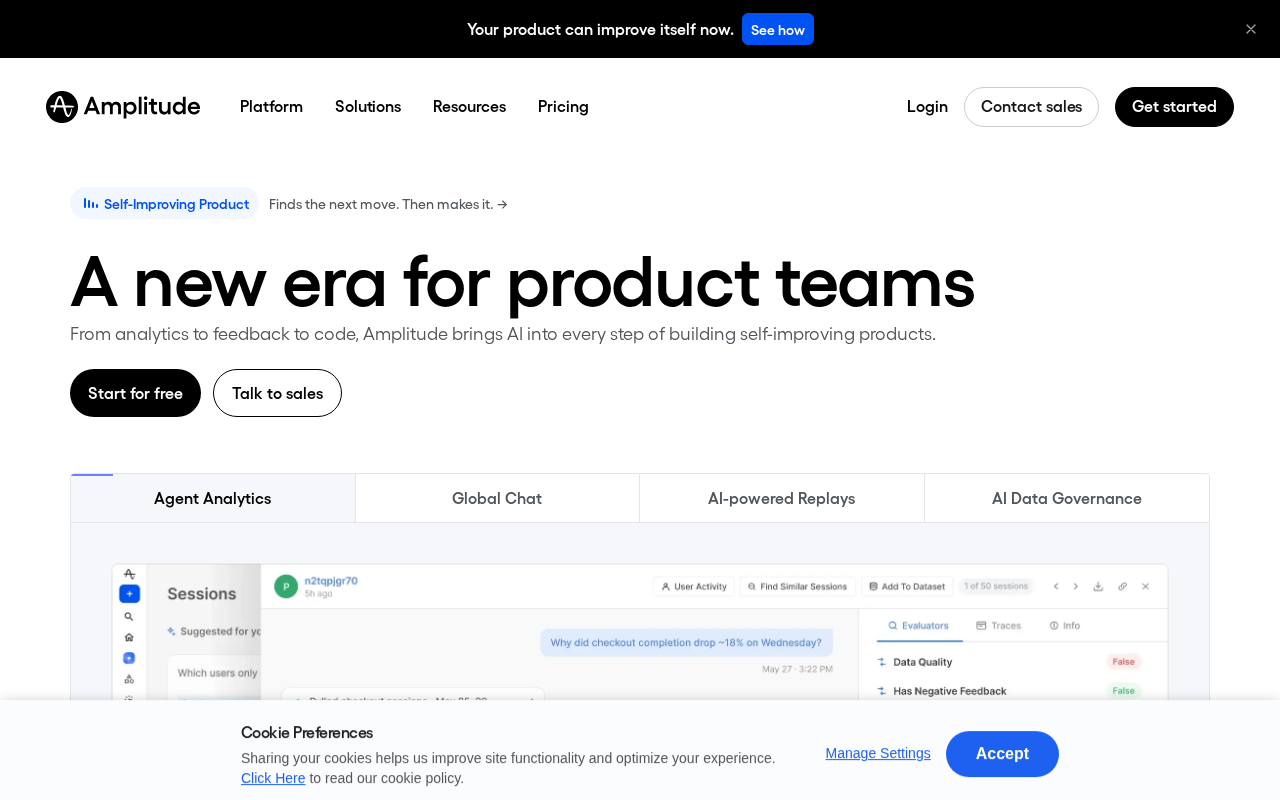
Amplitude is a digital analytics platform built on events: each action a user takes in a product becomes an event with properties, so teams can read funnels, retention, and feature adoption without writing SQL. The suite covers product analytics, experimentation and A/B testing, session replay, and customer data activation that syncs behavioral audiences to engagement tools. A Warehouse Native deployment queries data directly in Snowflake or Databricks rather than copying it, which is the draw for enterprises that already keep behavioral data in a warehouse. Metering is the part buyers most often misread. Amplitude counts monthly tracked users (MTUs), defined as unique users who trigger at least one event in a calendar month, alongside event volume. The Free plan includes 2M events and 50,000 MTUs per month with no credit card, capped at 1,000 events per MTU. Plus is usage based: the first 2M events cost nothing and the plan scales to 70M events and 700,000 MTUs, with overage billed at the same per unit rate as the plan and usage alerts at 80%, 90%, 100%, and 110%. Growth and Enterprise are quoted by sales, and a Startup Scholarship covers one free year of Growth for companies that have raised under $10M with fewer than 20 employees. AI features sit under the Amplitude AI label: named agents including Global Agent, Dashboard Agent, and Session Replay Agent, predictive audiences, anomaly detection, and an MCP server that connects Claude, Cursor, and other MCP clients on every plan including Free. Wave, described as a proactive product agent, is listed as reaching customers in the second half of 2026. Amplitude's own comparison pages frame it against Google Analytics 4 as self service across the full customer journey rather than a web and ads point solution, and against Mixpanel as one suite with experimentation, session replay, and CDP included.
AI Capabilities
- AI root cause analysis
- Predictive analytics
- AI anomaly detection
- AI-powered recommendations
- Natural language queries
Key Integrations
Pricing
Amplitude is freemium, with a free tier to start.
Free plan: 2M events and 50,000 MTUs per month, no credit card. Plus: usage based, first 2M events free, scaling to 70M events and 700,000 MTUs, overage at the plan's per unit rate. Growth and Enterprise quoted by sales.
Current plans and limits live on the Amplitude pricing page.
Best for
Product-led growth teams that need event analytics, funnels, and experimentation in one place, and enterprises that want warehouse-native querying against Snowflake or Databricks.
Not for
Teams that mainly need channel-level marketing reporting; GA4 covers acquisitions and campaigns at zero cost. Amplitude earns its price when product behavior questions drive decisions.
Review notes
Assessed from Amplitude's public docs, pricing pages, and comparison pages; we have no account. Amplitude is product analytics: events, funnels, retention, and now AI-generated insights. The strength is the event model, which lets you ask product questions without SQL. Funnel analysis and behavioral cohorts are the core reports. The learning curve is real but shallow enough for a data-literate marketer.
It helps to separate product analytics from web analytics. GA4 reports sessions, pageviews, and campaigns; Amplitude reports behavior: which features people use, in what order, and what the power users do differently. Marketing teams that only need channel reporting are fine in GA4. Teams that need to explain why retention moved or which feature drives upgrade need an event model like this one. The practical test: if your questions start with 'which segment' or 'what behavior' rather than 'which channel', you are in product analytics territory.
Instrumentation is the real cost. The free plan is generous, but the data is only as good as the tracking plan behind it: someone has to name events, define properties, and keep the taxonomy sane as the product changes. Amplitude's partnership with Segment and its warehouse-native setup (querying data in Snowflake or Databricks instead of duplicating it) reduce that work for teams that already have pipelines. Teams starting from zero should budget effort for the tracking plan before budgeting for the plan tier.
Pricing has a generous entry point and scales steeply past it. As published in September 2026 the free plan covers 2M events and 50,000 MTUs per month, Plus is usage based with the first 2M events free and a ceiling of 70M events and 700,000 MTUs, and Growth and Enterprise are quoted by sales. Amplitude publishes no per tier dollar figure, so budget from the event volume calculator on its pricing page. Event volume is the part to watch: traffic spikes, bot traffic, and sloppy instrumentation all inflate the bill.
Verdict
Standard choice for product-led companies. For pure marketing analytics, Google Analytics 4 covers more channels with less cost.
Pros and cons
| Pros | Cons |
|---|---|
| ✓ AI capabilities: AI root cause analysis | ✗ Closed source - no self-hosting option |
| ✓ G2 rating 4.5/5 | |
| ✓ Native integrations include Segment, Snowflake, Salesforce (8 listed) | |
| ✓ Free tier to evaluate before committing (Free plan: 2M events and 50,000 MTUs per month, no credit ca) |
Building your martech shortlist?
The weekly newsletter: one tool teardown, one workflow, no fluff. Free.
Frequently asked questions
What is Amplitude?
AI-powered digital analytics platform for product and marketing teams. It ships with AI root cause analysis, 8 listed integrations. MartechSignal's review covers features, pricing, and how it compares to alternatives.
How much does Amplitude cost?
Four. Free: 2M events and 50,000 MTUs per month, 10 saved charts, 1,000 session replays, one year of data access, no credit card.
Is Amplitude a good Analytics & Attribution tool in 2026?
Standard choice for product-led companies. For pure marketing analytics, Google Analytics 4 covers more channels with less cost.
Does Amplitude have heatmaps?
Not as classic click and scroll overlays. Amplitude's closest equivalents are session replay and journey analysis, which reconstruct where users struggle after the fact. If heatmap overlays are the requirement, tools like Hotjar or Microsoft Clarity fill that gap, and both pair fine with Amplitude data.
What are Amplitude's pricing tiers?
Four. Free: 2M events and 50,000 MTUs per month, 10 saved charts, 1,000 session replays, one year of data access, no credit card. Plus: usage based, first 2M events free, scaling to 70M events and 700,000 MTUs, two year retention, 20 behavioral cohorts, credit card required. Growth and Enterprise: both quoted by sales, with Enterprise adding unlimited projects, RBAC and SCIM, 50,000 replays, and a one business day SLA. A Startup Scholarship covers one free year of Growth for companies under $10M raised with fewer than 20 employees. Amplitude publishes no per tier dollar table; Plus is priced through an event volume calculator on its pricing page.
What is an MTU in Amplitude, and what happens if I exceed my limit?
An MTU is a unique user who triggers at least one event in your product in a calendar month. Anonymous users count by device ID, known users by user ID, and a person counts once across projects. The Free plan allows 50,000 MTUs and caps each at 1,000 events per month. On paid plans the limit is the MTU volume you purchase, and exceeding it can bring overage charges: each extra 1,000 events converts to one MTU at the plan's per unit rate, with alerts at 80%, 90%, 100%, and 110%. On Free, crossing the limit three times blocks the account; Amplitude keeps ingesting data but you cannot read it until you upgrade, and the account is deleted after six months over limit.
Amplitude vs Mixpanel: which should you pick?
Mixpanel is cheaper and does event analytics well, which is enough if behavioral charts are the whole job. Amplitude's comparison page argues for more than a point solution: experimentation, session replay, and a customer data platform in the same suite, plus autocapture, governance, and support it credits Mixpanel with lacking. Treat that as vendor framing. The practical test is whether you would buy a separate testing or replay tool anyway; if not, Mixpanel at a lower price point is the rational pick.
Do you need Amplitude if you already have Google Analytics 4?
They answer different questions. GA4 is built around acquisition, meaning which campaign or channel brought the visit, and it costs nothing. Amplitude is built around in product behavior: what a user did after arriving, which features retain, where a funnel breaks. Teams running a product led motion usually keep GA4 for channel reporting and add Amplitude for product decisions; teams that only need channel reporting usually do not need Amplitude at all. Amplitude's own comparison page positions GA4 as a web and ads point solution that depends on BigQuery for deeper analysis, which is the vendor's framing rather than an independent verdict.
Does Amplitude have AI features?
Yes. Amplitude AI is the umbrella for named agents including Global Agent, Dashboard Agent, Session Replay Agent, and Customer Feedback Agent, plus custom agents, predictive audiences, and automated anomaly detection. An MCP server connects Claude, Cursor, and other MCP clients, and Amplitude states it works on every plan including Free. Wave, described as a proactive product agent, is listed as reaching customers in the second half of 2026. Scope moves often; Amplitude's AI docs carry the current list.