AlphOne Review
Plugin-first open-source CRM written in Go
CRM · Open Source · OPEN SOURCE
Overview
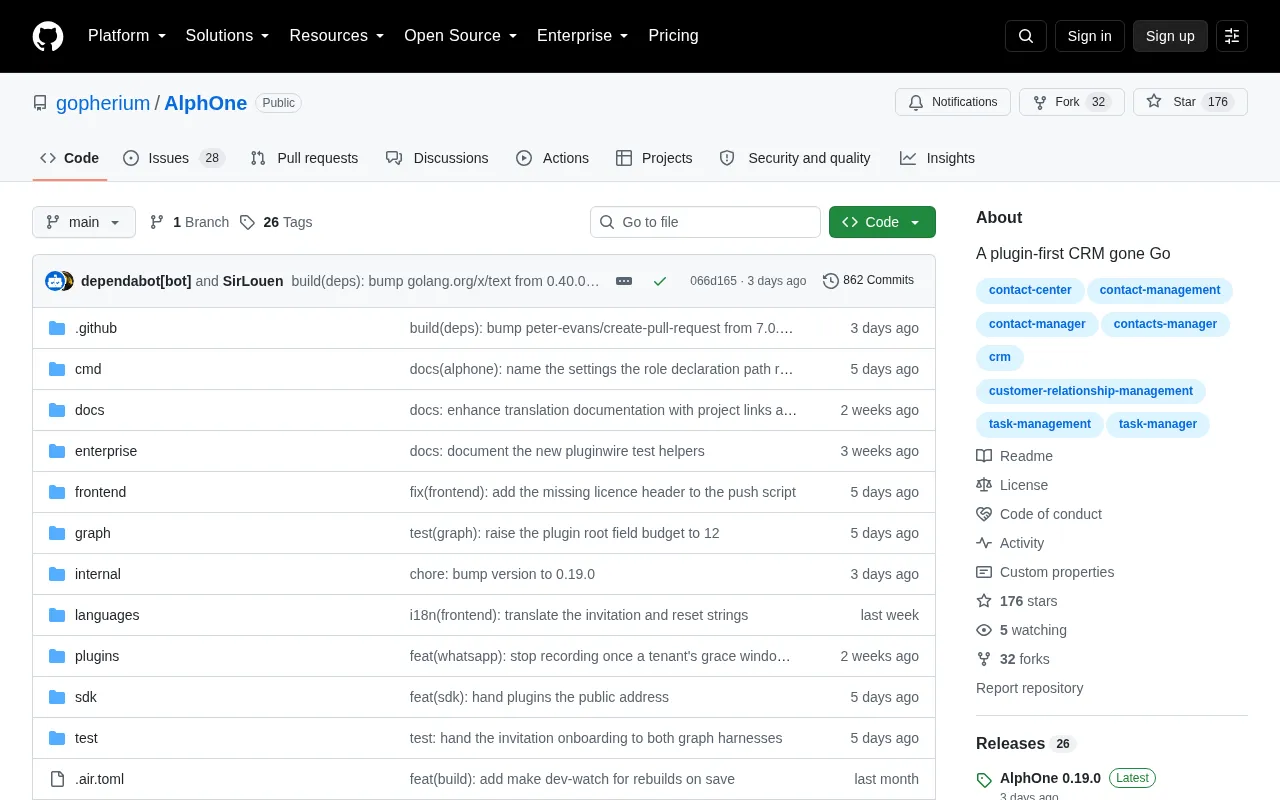
AlphOne is a plugin-first CRM with a Go backend exposing both GraphQL and REST APIs, a React single-page frontend, and a design that treats automation as an external concern: there is no built-in rules engine, because everything the UI does is available over HTTP with a token. Features ship as plugins with their own repositories; the current in-repo set covers fields, an importer, and a WhatsApp Cloud API channel that lands customer conversations in a shared inbox attached to the right contact. For marketing ops the notable part is how deliberately the project meets agents where they already work: it speaks MCP (Model Context Protocol) natively, so any MCP client can ask about today's tasks or waiting contacts, and there is a community n8n node (n8n-nodes-alphone) with documented end-to-end workflows, such as an inbound WhatsApp message creating a write-back task on the right contact. The same API-first logic works with Activepieces, Windmill, Node-RED, or a cron job with curl. Licensing needs a look before you commit: the Go backend and SQL migrations carry the Elastic License 2.0, which forbids offering AlphOne to third parties as a hosted service, while the frontend, tests, and docs are AGPLv3. That split is workable for a company extending a self-hosted CRM in Go, and rules out SaaS vendors reselling hosted CRM. At 176 stars the community is early-stage, but the repo ships with code coverage, sqlc, GraphQL codegen, and an active commit log. Evaluate it as an API-first foundation for an n8n- or agent-driven stack, not a finished SuiteCRM replacement.
Best for
Marketing ops teams that already run n8n or AI agents and want a CRM those tools can drive natively - MCP support and the n8n community node make AlphOne addressable without middleware.
Not for
Teams wanting a finished, feature-complete CRM on day one (the plugin catalogue is young), and SaaS vendors reselling hosted CRM - the Elastic License 2.0 backend forbids exactly that.
Hands-on notes
The README is short and the documentation lives on a separate docs site, which tells you where the project is in its lifecycle: the code and setup path are real (Go backend, React SPA, plugin repositories per feature), but the marketing surface is minimal. The plugin-first model means most evaluation effort goes into reading the plugin catalogue rather than feature pages. Claims here rest on the repository itself; we have not run a self-hosted instance.
From the documentation (we have not run AlphOne ourselves): AI access is native rather than bolted on. AlphOne speaks MCP from version 0.9.0, so any MCP client can query tasks, contacts, and fields through a defined tool list. The catch is the license, not the tech: Elastic License 2.0 on the backend means no offering AlphOne as a hosted or managed service to third parties, while the frontend carries AGPLv3. If your use case is internal CRM on your own infrastructure, neither restriction bites. If you build client solutions, read both licenses before writing any code against the API.
The automation story is the differentiator and it is documented, not implied: AlphOne has no built-in rules engine, and the docs say so plainly. Everything the frontend does runs over the same HTTP API a token unlocks, so an external engine drives the CRM the way the UI does. The docs walk an n8n workflow end to end - an inbound WhatsApp message creating a 'write back to contact' task - using the community node n8n-nodes-alphone, and mark automated records so humans can tell agent-made work from human-made work. We have not run AlphOne ourselves; this is assessment from the live documentation and repository.
AI access is native rather than bolted on. AlphOne speaks MCP, the same protocol Claude Code and other agent clients use, from version 0.9.0 onward: you mint a token, connect an MCP client, and the agent can query tasks, contacts, and fields through a defined tool list. For a marketing ops team already running agents, that means the CRM is addressable by the same infrastructure that runs everything else, without a vendor middleware layer in between. The GraphQL and REST APIs plus webhooks cover the cases MCP does not.
Self-hosting is a single container image with a compose file, an environment file, and a reverse proxy - the install guide runs four steps. Updates and backups have their own documented procedures, and translation flows through POEditor with a weekly sync rather than direct commits. The plugin catalogue is the honest weak spot at this stage: fields, an importer, and WhatsApp are in-repo, and evaluation effort goes into reading the plugin repositories to see what exists versus what the roadmap promises.
Verdict
An API-first CRM built to be driven by n8n and AI agents rather than replace them. Early-stage, split-licensed, and best judged as a foundation for an automated stack.
Pros and cons
| Pros | Cons |
|---|---|
| ✓ Open-source licensing with free self-hosting | ✗ Young project (176 GitHub stars) - smaller community and plugin ecosystem |
| ✓ API access for custom integrations |
Building your martech shortlist?
The weekly newsletter: one tool teardown, one workflow, no fluff. Free.
Frequently asked questions
What is AlphOne?
Plugin-first open-source CRM written in Go. It ships with 176 GitHub stars, an API for custom integrations. MartechSignal's review covers features, pricing, and how it compares to alternatives.
How much does AlphOne cost?
AlphOne is open source and free to self-host. Hosted plans may add support and managed features.
Is AlphOne a good CRM tool in 2026?
An API-first CRM built to be driven by n8n and AI agents rather than replace them. Early-stage, split-licensed, and best judged as a foundation for an automated stack.