Mailchimp Review
All-in-one marketing platform with AI-powered email, automation, and analytics
Email Marketing · Freemium
Overview
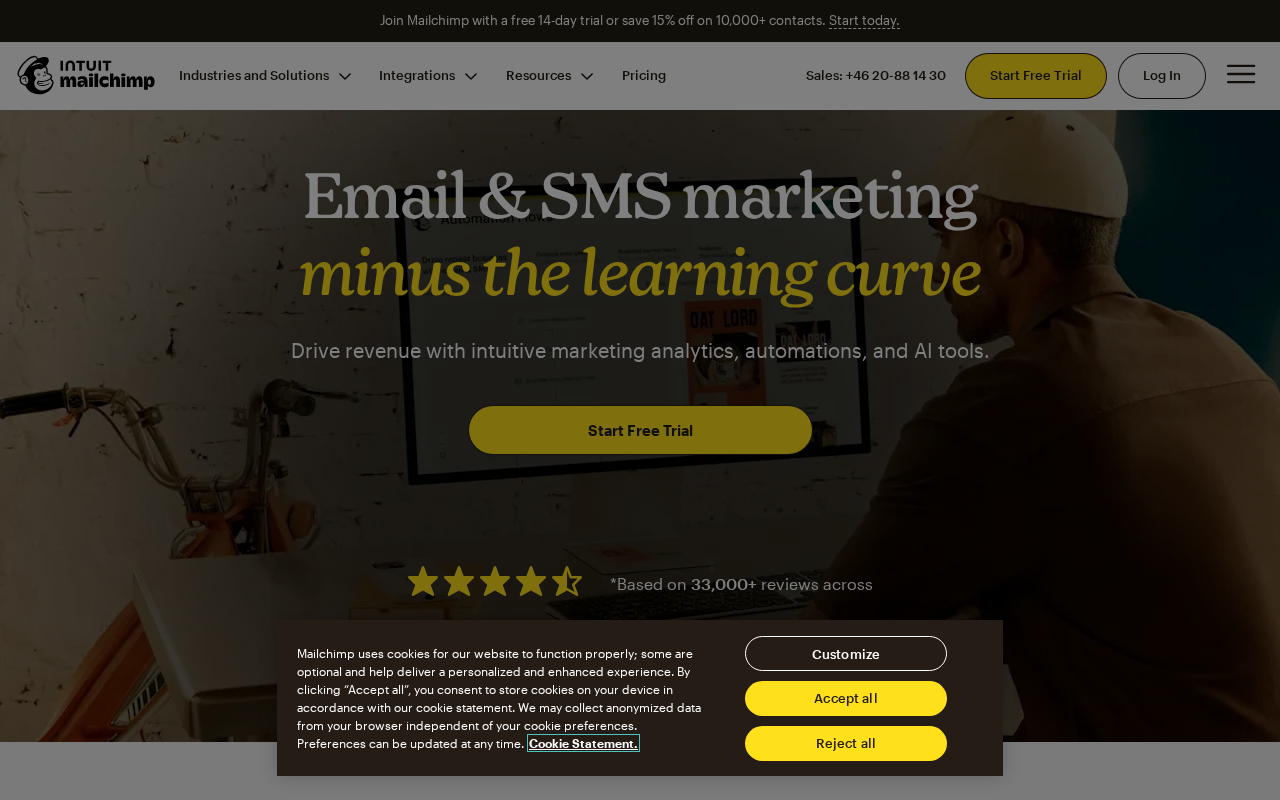
Mailchimp is the most recognized name in email marketing, serving over 11 million users from solopreneurs to mid-market businesses. Founded in 2001 in Atlanta and acquired by Intuit in 2021 for $12 billion, it has expanded far beyond email into a full marketing platform that also includes landing pages, social media ads, postcards, SMS, marketing automation, and a basic CRM. Its core strength remains accessibility: the drag-and-drop email builder, template library, and guided setup make it the default starting point for businesses that need to send professional emails without technical skills. Intuit Assist, Mailchimp's AI layer, generates email copy, suggests subject lines, and recommends send times. The free plan supports up to 500 contacts and 1,000 emails/month, though it has been progressively trimmed since the Intuit acquisition. Paid plans start at $13/month for 500 contacts on the Essentials tier, with the Standard plan at $20/month adding automation and A/B testing. Mailchimp's transition from independent email tool to Intuit subsidiary has been a mixed experience for users: pricing has increased several times, the free plan limits have been reduced, and the platform sometimes feels like it's being pushed toward Intuit's broader QuickBooks ecosystem. For ecommerce brands, Klaviyo offers deeper Shopify integration. For SaaS, Customer.io and Loops are more event-driven. But for the small business that needs to send a newsletter, build a landing page, and run Facebook ads from one tool, Mailchimp still delivers the most complete out-of-the-box experience.
AI Capabilities
- AI content optimizer
- AI subject line helper
- Predictive demographics
- AI send-time optimization
- Creative assistant
Key Integrations
Pricing
Mailchimp is freemium, with a free tier to start, paid plans start at $13/mo.
Free plan (500 contacts, 1,000 emails/mo); Essentials $13/mo; Standard $20/mo; Premium $350/mo
Current plans and limits live on the Mailchimp pricing page.
Review notes
Researched from public documentation, the source repository, and vendor materials. Not a hands-on test.
Mailchimp is the entry point for a huge share of small teams, and the current product shows both halves of that inheritance: genuinely capable email, templates, and automation for casual senders, and a growing AI layer, while the platform around it has become noticeably busy with upsells and plan limits. The free tier is real and generous enough for tiny lists, which keeps it the default first-tool.
The pain shows up at the growth boundary: automations, segmentation depth, and delivery tooling get paywalled or throttled, and the jump to paid tiers is steeper than competitors with comparable features. It is also not a commerce-first platform, so ecommerce teams outgrow it toward Klaviyo or a CDP-driven stack.
Verdict
Fine as a starting point, especially free. Budget to migrate once automation depth or list size starts to strain the plan structure.
Pros and cons
| Pros | Cons |
|---|---|
| ✓ AI capabilities: AI content optimizer | ✗ Paid plans start at $13/mo once past the free tier |
| ✓ G2 rating 4.4/5 | ✗ Closed source - no self-hosting option |
| ✓ Native integrations include Shopify, WooCommerce, Salesforce (8 listed) | |
| ✓ Free tier to evaluate before committing (Free plan (500 contacts, 1,000 emails/mo); Essentials $13/mo) |
Building your martech shortlist?
The weekly newsletter: one tool teardown, one workflow, no fluff. Free.
Frequently asked questions
What is Mailchimp?
All-in-one marketing platform with AI-powered email, automation, and analytics. It ships with AI content optimizer, 8 listed integrations. MartechSignal's review covers features, pricing, and how it compares to alternatives.
How much does Mailchimp cost?
Mailchimp has a free tier; paid plans start at $13/mo.
Is Mailchimp a good Email Marketing tool in 2026?
Fine as a starting point, especially free. Budget to migrate once automation depth or list size starts to strain the plan structure.